

Your shopping cart is empty!
Dill "Kibray"
New
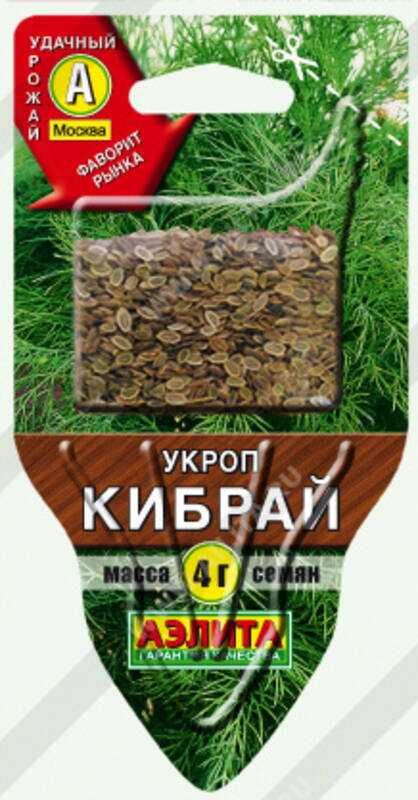
Dill “Kibray” — Anethum graveolens.
A popular high-yielding variety for obtaining greens and spices.
Late-ripening: from germination to harvesting for greens — 30—40 days, for spices — 60—80 days.
The rosette is lush, with 10—12 large leaves 20—25 cm long.
The bush is erect, tall, and very leafy. The leaves are green, juicy, tender, aromatic, and of high commercial quality. Due to its high resistance to bolting, it retains the phase of economic suitability for a long time. All aerial parts of the plant contain essential oil and have a very pleasant taste.
For earlier greens, dormant autumn sowing is possible in late October — early November. The optimal distance between plants is 20×5 cm.
Make furrows with the pointed edge of the packaging.
Dose the seeds accurately when sowing.
Mark the sowing place after embedding the seeds in the soil.
A popular high-yielding variety for obtaining greens and spices.
Late-ripening: from germination to harvesting for greens — 30—40 days, for spices — 60—80 days.
The rosette is lush, with 10—12 large leaves 20—25 cm long.
The bush is erect, tall, and very leafy. The leaves are green, juicy, tender, aromatic, and of high commercial quality. Due to its high resistance to bolting, it retains the phase of economic suitability for a long time. All aerial parts of the plant contain essential oil and have a very pleasant taste.
For earlier greens, dormant autumn sowing is possible in late October — early November. The optimal distance between plants is 20×5 cm.
Make furrows with the pointed edge of the packaging.
Dose the seeds accurately when sowing.
Mark the sowing place after embedding the seeds in the soil.
* Almost all gardeners plant dill, but it does not grow green and thick for everyone. Sometimes only thin blades of yellowish or reddish tint appear in the beds. And sometimes dill does not sprout at all...
This seemingly simple crop has its secrets. Dill grows green only on soils fertilized with organic fertilizers.
Before sowing, the soil is not limed, and ash is not added, otherwise the plantings will turn red. Do not sow dill in a shaded place: the plants will stretch out and be pale.
And to prevent dill from "bolting" early, try not to overdry the soil, always keeping it moist.
Before planting, wash the seeds in hot water, so you will wash off the essential oil that prevents germination. Check the germination rate; to do this, soak them for 2—3 days in a wet cloth. If the seeds do not sprout during this time, use them as a seasoning; they are not suitable for planting.
Fertilize the soil with humus (1/3 bucket per 1 m²), add 1 tablespoon of nitrophoska or complex mineral fertilizer to it. Instead of humus, you can shed the furrows with diluted mullein in a ratio of 1:10.
You can sow dill very early, around April 1—10, directly over the ice crust, but only dry seeds are used for such planting. Most often, dill is sown on April 20—25. It is better to sow it not in a single line, but in a wide furrow of 5 cm. The seeds are scattered in it in a zigzag pattern, then the plants will not fall during thinning. The furrows are pre-watered, dill is sown to a depth of 1—2 cm. The plantings are covered with humus and no longer watered. The plants are thinned out in the phase of 2—3 true leaves, leaving a distance of 8—10 cm between them. Dill is not fed during growth. Water it once every seven days, and in hot, dry weather — twice a week. The crop ripens in 3—4 weeks after the emergence of seedlings, when the greens reach 15—20 cm. They are pulled out right with the root.
Dill is most aromatic during the budding period, when its top thickens, but it does not bloom yet. At this time it is dried, frozen, pickled, or used to flavor vinegar. Fully ripened umbels are cut for seeds. They are stored in a tightly closed jar; germination is maintained for 2—3 years.
Repeated sowing of dill is carried out every 15—20 days; the last sowing is recommended no later than August 20.
Most often, gardeners do not think about what variety of dill to choose for planting, but knowing this is very important:
Gribovsky — an early-ripening variety, sown early in spring, not demanding to the weather.
Kibray — a late-ripening variety, gives good greens under a film.
Zontik — similar to Gribovsky, but more productive.
Lesnogorodsky — very productive and aromatic, yields excellent greens even in September.
Salyut — the first Russian bush variety. During cultivation, it requires mandatory thinning. To get bushes, distances of 15—20 cm are left between plants. Before sowing, the seeds are warmed up for 30 minutes in hot water (temperature +48—50 °C), then they are cooled in cold water and dried.
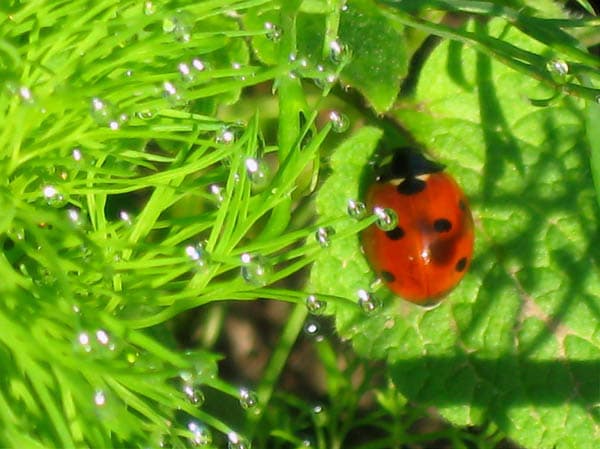
Useful tip: Ladybugs are wonderful allies in pest control.
To attract them to the greenhouse, plant dill next to cucumbers. Ladybugs really like its smell during flowering.